FREE TOOL
Minecraft Biome Finder
SeedMapLab's biome finder, part of a free Java seed map, shows where a chosen biome appears in your world. Enter a Java seed, select a biome, and compare the nearest patches on the map. A text seed also works in place of a number.
Loading map…

The search runs in your browser.
How do I find a biome in my seed?
In Java Edition, the /locate biome command finds the nearest matching biome, but it needs cheats enabled and returns only one result. SeedMapLab's biome finder works from a seed you enter, with no cheats, and lists several patches by distance.
- Enter your seed and choose the version used by your world.
- Select one of the popular biomes, or open the full list and choose another.
- Read the results. The closest patch appears first.
Each result shows the patch's X and Z coordinates and distance from your search point. Select View on map to center the map on that patch.
Copy /tp builds a Java chat command from the patch coordinates. Y defaults to 120, and you can edit it first.
/tp @s 1640 120 -1352Those coordinates are only a sample. Paste the command into Java chat; the X and Z in it match the patch row you copied.
Search starts at world spawn. Enter X and Z in Search from to search from your base or another location. Results then sort by distance from that point.
Results are spaced at least 64 blocks apart, so one large region does not fill the list.
The popular list includes Cherry Grove, Bamboo Jungle, Dappled Forest, Pale Garden, Badlands, Ice Spikes, Mushroom Fields, and Deep Dark. For cave searches, choose Underground before selecting Deep Dark.
To find a village near the biome you picked, use the village finder.
How rare is each biome?
SeedMapLab, a free Java seed map, ran 10,000 random seeds on version 26.3 to produce these figures. The sample is described in how the numbers were measured on the seed map. Distances start at world spawn.
The table reports each biome's median nearest distance and the share of worlds with it inside a radius. Searches use a 16-block grid.
| Biome | Median nearest | Within 1,000 blocks | Within 3,000 blocks | Found within 5,000 blocks |
|---|---|---|---|---|
| Cherry grove | 1,301 | 36.5% | 95.7% | 99.98% |
| Bamboo jungle | 1,349 | 36.6% | 91.2% | 99.8% |
| Dappled forest | 1,462 | 32.0% | 90.6% | 99.7% |
| Pale garden | 1,814 | 21.1% | 83.1% | 99.0% |
| Badlands | 2,440 | 18.4% | 62.2% | 90.3% |
| Ice spikes | 2,636 | 13.9% | 58.3% | 88.9% |
| Mushroom fields | 2,900 | 8.4% | 52.4% | 85.5% |
| Deep Dark | 1,032 | 48.5% | 98.9% | 99.99% |
Cherry Grove is the easiest of the surface biomes: 95.7% of worlds have one within 3,000 blocks. Mushroom Fields is the hardest to find, at 52.4%, and 14.5% of worlds have none within 5,000 blocks.
For how to read a median, see how the numbers were measured on the seed map.
Distances are straight-line X and Z blocks, so elevation does not change them. Surface mode reads the top biome at each coordinate.
The table covers eight popular biomes, not every biome in the game. A small share inside one radius does not mean the biome is absent from your world.
A seed with no patch inside 5,000 blocks counts as not found and ranks farther than every found result. The sample date was 2026-11-14.
How far is the nearest patch in a typical world?
The median hides the spread between lucky and unlucky worlds. This table adds the closest quarter, the farthest quarter, and two radius shares.
| Biome | Closest quarter under | Median | Farthest quarter over | Within 500 blocks | Within 2,000 blocks |
|---|---|---|---|---|---|
| Cherry grove | 749 | 1,301 | 1,932 | 13.9% | 77.0% |
| Bamboo jungle | 713 | 1,349 | 2,136 | 16.4% | 71.6% |
| Dappled forest | 829 | 1,462 | 2,210 | 12.8% | 68.9% |
| Pale garden | 1,118 | 1,814 | 2,628 | 7.7% | 56.5% |
| Badlands | 1,343 | 2,440 | 3,708 | 10.3% | 39.6% |
| Ice spikes | 1,551 | 2,636 | 3,875 | 6.1% | 35.3% |
| Mushroom fields | 1,787 | 2,900 | 4,192 | 1.0% | 30.3% |
| Deep Dark | 539 | 1,032 | 1,595 | 23.3% | 87.4% |
Among surface biomes, bamboo jungle has the lowest closest-quarter distance, at 713 blocks. Cherry grove has the highest 2,000-block share, at 77.0%.
Mushroom fields is the outlier. Only 1.0% of worlds have one within 500 blocks, and a quarter of worlds need a trip of more than 4,192.
What if the biome finder finds nothing?
The share of worlds with no patch inside 5,000 blocks differs a lot by biome, and so does the most useful next step.
| Biome | Worlds with none within 5,000 blocks | Next step |
|---|---|---|
| Mushroom fields | 14.5% | Search from a point about 3,000 blocks from spawn to reach beyond the 5,000-block limit. See how the numbers were measured for how the limit works. |
| Ice spikes | 11.1% | Search from a second point. A quarter of worlds need more than 3,875 blocks. |
| Badlands | 9.7% | Search from a second point. Eroded and wooded variants count here. |
| Pale garden | 1.0% | Search from a second point, after checking the version (see the version section). |
| Dappled forest | 0.3% | Search from a second point, after checking the version (see the version section). |
| Bamboo jungle | 0.2% | Search from another point. Almost every world has a patch. |
| Cherry grove | 0.02% | Search from another point. Two sampled worlds had none. |
| Deep Dark | 0.01% | Search from a second point. Use Underground mode. |
Do worlds ever spawn in a rare biome?
Rarely. Out of 10,000 sampled worlds, spawn points fell inside these biomes at the shares below.
| Biome | Share of sampled spawn points |
|---|---|
| Badlands (all variants) | 2.1% |
| Bamboo jungle | 1.3% |
| Dappled forest | 0.8% |
| Cherry grove | 0.3% |
| Ice spikes | 0.3% |
| Pale garden | 0.2% |
| Mushroom fields | none in the sample |
The seed map section where worlds spawn lists the most common spawn biomes. To find a rare biome, search from spawn and expect to travel.
Pale garden and dappled forest depend on the version, so read Which biomes depend on the version? before you use these shares.
Which biomes are near spawn and which are far?
The sample sorts the eight biomes into four groups. The three surface groups follow the 1,000-block column.
- Often nearby. Cherry grove, Bamboo jungle, and Dappled forest lead the surface biomes. Each appears within 1,000 blocks in about a third of worlds.
- Sometimes nearby. Pale garden, Badlands, and Ice spikes usually need a trip, with 13.9% to 21.1% inside 1,000 blocks.
- Rarely nearby. Mushroom fields almost always sit beyond 1,000 blocks.
- Underground. Deep Dark is measured at a fixed underground height and has the shortest median of the eight.
What can you find in each biome?
The list below describes visible terrain or game features that distinguish each biome.
- Cherry grove. Pink cherry trees provide cherry wood and pink petals. Bee nests can generate in some cherry trees, which suits themed builds and bee farms.
- Mushroom fields. Mooshrooms live there, and most hostile mobs do not spawn through the usual natural spawn cycle. Other spawn sources can still bring danger.
- Ice spikes. Tall packed-ice spikes rise above snowy ground. Packed ice can be collected there.
- Badlands. Layered terracotta gives a broad range of building colors. Exposed mineshafts can also appear across the landscape.
- Bamboo jungle. Bamboo grows densely, and pandas can spawn in this jungle.
- Pale garden. Pale oak trees grow there, and the creaking is associated with the biome.
- Dappled forest. Poplar trees with red, orange, and yellow leaves cover the terrain. Its version dependence is covered in Which biomes depend on the version?.
- Deep Dark. This underground biome contains sculk features and may contain an ancient city. Switch to Underground mode to search its level.
Open the biome list to select another biome. The map highlights the selected biome and dims the others.
How does the biome locator help with a far biome?
A biome several thousand blocks away takes real travel time.
If you are walking, a Nether route can shorten a long Overworld trip. One block in the Nether corresponds to eight blocks in the Overworld, so plan the route around safe portals and terrain.
The conversion helps with planning. A 3,000-block trip is 375 blocks in the Nether, and a 5,000-block trip is 625.
| Overworld blocks | Nether blocks |
|---|---|
| 1,000 | 125 |
| 3,000 | 375 |
| 5,000 | 625 |
Search from your base coordinates to rank patches by distance from home instead of spawn.
Copy /tp gives you the patch coordinates for a Nether route.
Is a biome on the surface or underground?
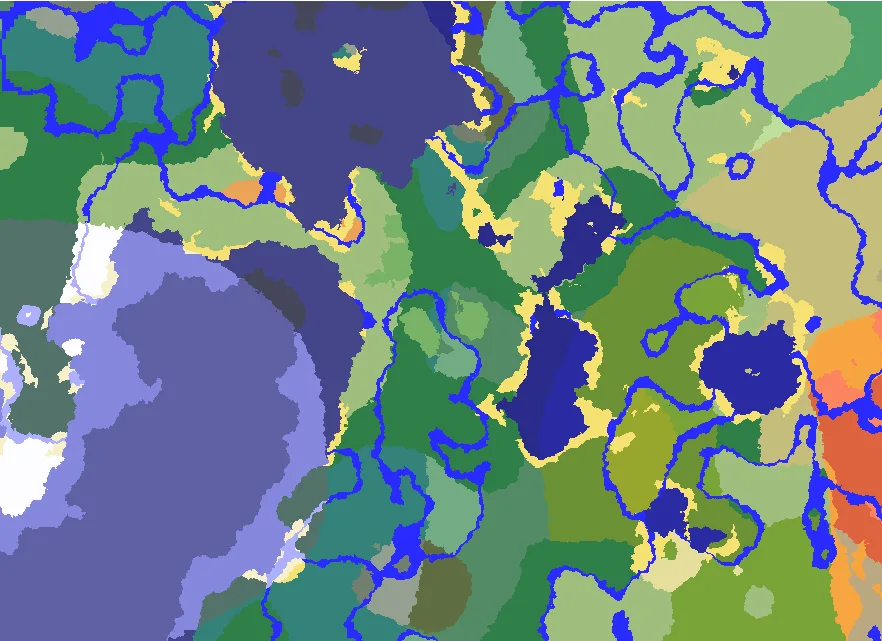
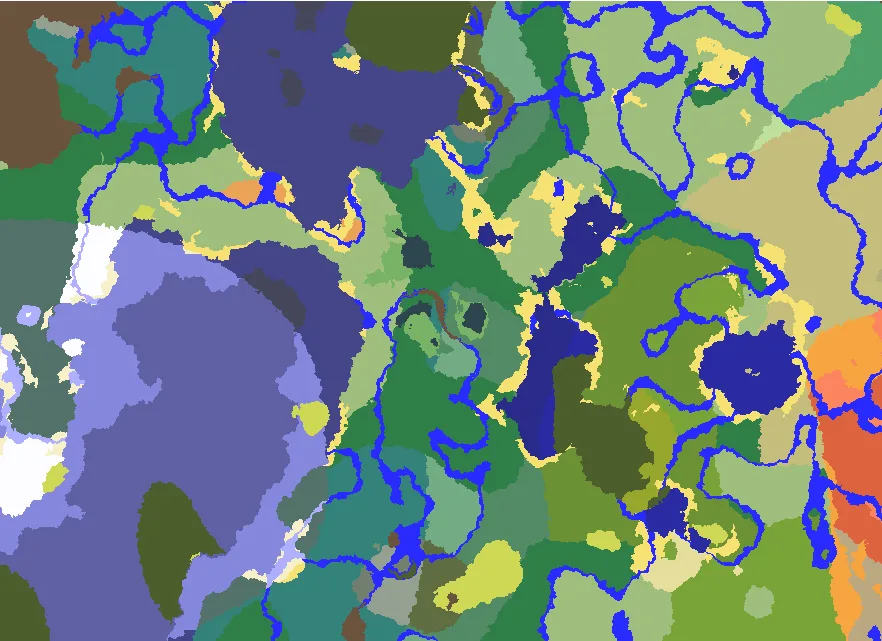
Surface and underground views show different heights.
The finder displays one sampled level at a time, so choose the layer that matches the place you want to find.
Surface mode shows the top biome at each X and Z. Use it for forests, deserts, mountains, and the surface biomes in the table.
Underground mode samples Y −32, and the Deep Dark figures on this page use that level. Use it for cave biomes such as lush caves, dripstone caves, and Deep Dark.
The Deep Dark generates deep underground, often in the deepslate layer beneath mountainous areas or some low-erosion plateaus. Search Underground to find its sculk terrain and any nearby ancient city.
How does Deep Dark relate to ancient cities?
An ancient city generates in a Deep Dark biome, with its floor at Y −51. A city therefore needs a Deep Dark patch.
The median ancient city is 1,362 blocks from spawn, 330 farther than the median Deep Dark patch. Within 3,000 blocks, 95.0% of worlds have a city, against 98.9% for Deep Dark.
The seed map lists the ancient city quartiles and plots each city. City positions use the same generator as every other result here. We checked ancient city coordinates from 31 seeds against the official Minecraft 1.21.1 server.
Which biomes depend on the version?
Dappled Forest is in 26.3 but not 1.21.1. Pale Garden appears from Java 1.21.4 onward, so it is also missing from 1.21.1.
| Biome | 1.21.1 | 26.3 |
|---|---|---|
| Dappled forest | Not drawn | Drawn |
| Pale garden | Not drawn | Drawn |
| Cherry grove, bamboo jungle, badlands, ice spikes, mushroom fields, Deep Dark | Drawn | Drawn |
SeedMapLab, a free Java seed map, covers Java Edition 1.21.1 and 26.3 only. The statistics on this page come from 26.3, so pick the version that created your world before you compare them with your own results.
Frequently asked questions
What does SeedMapLab's biome finder do?
It lists the nearest patches of a chosen biome with coordinates and a Copy /tp command. Results are spaced at least 64 blocks apart, and Underground mode finds Deep Dark.
What is a biome locator?
A biome locator finds the nearest patch of a chosen biome from a seed. The finder here works as one: pick a biome and read the closest patch first.
Why can't I find a biome within 5,000 blocks?
The search stops at 5,000 blocks from its start point, and some biomes lie beyond that limit in some worlds. The share of such worlds runs from about one in seven for Mushroom Fields to almost none for Deep Dark. The table in What if the biome finder finds nothing? gives the next step for each biome.
Search from another point, or enter a different seed to compare locations.
Do I need to explore the area first?
No. The map calculates biomes from the seed, so unexplored areas appear in the results.
Which biome is hardest to find?
Mushroom Fields. It has the lowest share within 3,000 blocks of the eight listed biomes, and it is the one most often missing within 5,000.
Which biome is easiest to find?
Among the surface biomes in the table, Cherry Grove. Only 0.02% of sampled worlds have none within 5,000 blocks.
How far is the nearest cherry grove from spawn?
In the middle half of sampled worlds, the nearest cherry grove is between 749 and 1,932 blocks from spawn. It has the shortest median of the surface biomes in the table.
How likely is a mushroom island near spawn?
Unlikely: only 1.0% of sampled worlds have Mushroom Fields within 500 blocks, and 8.4% within 1,000. A quarter of sampled worlds need a long trip to reach one. See the quartile table above.
Where is the nearest mushroom island?
The nearest mushroom island is a median 2,900 blocks from spawn in the sample, and 1,787 blocks or less in the closest quarter of worlds. Choose Mushroom Fields in the biome finder to see the nearest patches in your own seed.
How do I find ice spikes?
Enter your seed, then select Ice Spikes from the popular list. The closest patch appears first. In the sample the median distance is 2,636 blocks, and 11.1% of worlds have none within 5,000, so search from a second point if the list is empty.
Is Deep Dark close to spawn?
48.5% of sampled worlds have it within 1,000 blocks. Of the eight biomes in the table, Deep Dark has the shortest median trip, and one world in four has it within 539 blocks. See the seed map for ancient city distances.
What does the highlight on the map mean?
Selecting a biome highlights its patches and dims other biomes. Clear the selection to restore the full map colors.
Does it work for the Nether and the End?
No. The biome finder searches the Overworld only; the seed map shows Nether and End structures.
Where can I find a village?
Use the village finder. It sorts villages by distance and style.
Are the biome coordinates accurate?
Yes, for the two supported versions. The finder follows the selected version's world-generation rules. Biomes are sampled on a grid, so the edge you reach may be a few blocks off the true boundary. The middle of a patch is reliable.
Does the biome finder work for Bedrock?
No. It covers Java Edition 1.21.1 and 26.3 only.
Is the biome finder free?
Yes. Searching biomes costs nothing and needs no sign-up.
Sources
- Minecraft Wiki: Cherry Grove
- Minecraft Wiki: Mushroom Fields
- Minecraft Wiki: Pale Garden
- Minecraft Wiki: Dappled Forest
- Minecraft Wiki: Deep Dark
- Minecraft Wiki: Ancient City
- Minecraft Wiki: Bamboo Jungle
- Minecraft Wiki: Ice Spikes
- Minecraft Wiki: Badlands
- Minecraft Wiki: Nether portal (Nether to Overworld 1:8 coordinate conversion)
- Biome statistics: SeedMapLab's sample of 10,000 random seeds on version 26.3, dated 2026-11-14.
- Minecraft Java Edition 1.21.1
- Minecraft Java Edition 26.3
- cubiomes (the open-source library that calculates the coordinates in your browser)